How much time do you have?
by AImmersive
A new genre of narrative gaming, powered by AI models we trained ourselves - narrative, voice, and speech recognition, all ours, all on bare metal. One demo proven. The next one lands July 13.

Palo Alto office · Warsaw office - happy to meet in person. Diligence pack within 24h of a reply.
by AImmersive
A new genre of narrative gaming, powered by AI models we trained ourselves. One demo proven - the next lands on Steam July 13. A focused bridge round to carry us from wishlists to first revenue - and to the VC seed after it.
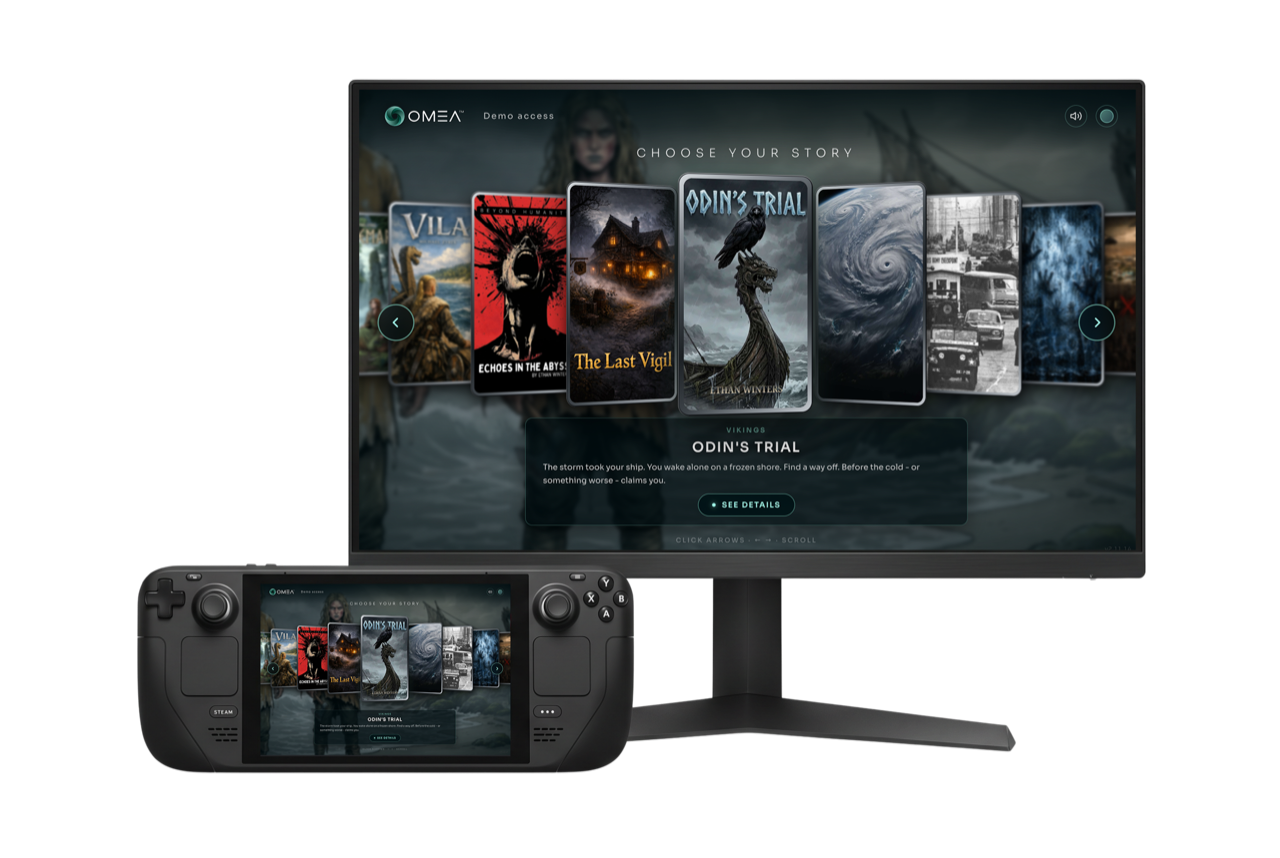
Omea is an AI-powered interactive narrative platform. You play through illustrated, fully voiced adventures by saying or typing what your character does. No dialogue wheels. No predetermined options. No invisible walls.
Negotiate, lie, run, fight, seduce, betray, try something the writers never anticipated. The AI narrates what happens next - in voice, text, and illustration.
Persistent memory across the entire session. Betray an ally in chapter one; watch it resurface hours later in ways no one explicitly programmed. Characters stay consistent. Consequences emerge organically.
Professional storytellers build the worlds, characters, and dramatic stakes. The AI handles what humans can't: tracking every thread, every relationship, every small decision, across hours of play.
Not a chatbot in a costume. A purpose-built narrative engine.


The full walkthrough - with up-to-date visuals - lives at omea.ai, and Omea is on Steam - wishlist it. If you'd rather judge it with a controller in hand: ask us for a Steam key and see it in action yourself.
We ran a 66-day public demo from March 6 to May 11, 2026. Real players, real load, real money on the line. This is what happened.
Players didn't click - they talked. A million words spoken into a microphone, to a story. That's the entire thesis of Omea, validated by behavior, not by survey.
End-to-end narrative responses, fully voiced, fully illustrated.
Cumulative output across the demo period.
Massive headroom on our infrastructure - more on this next.
Every other AI gaming company is paying OpenAI, Anthropic, or a voice API on every player interaction. We're not - on any layer. Our own narrative model. Our own text-to-speech model. Speech recognition on the player's device. All served from bare-metal machines. No third party anywhere in the loop.
Not fine-tuned on top of a general-purpose LLM. Trained. On 155,000+ licensed novels. Built for storytelling, not chat. There is no off-the-shelf substitute.
Tracks emotional history, broken promises, character relationships across the entire session - not just the last few exchanges. RAG-class systems can't approach this.
Every line of narration and dialogue is voiced by a TTS model we own and serve ourselves - no per-character fees to a voice API, no third party between our stories and the player's ears.
Speech recognition runs locally inside the game - zero cloud transcription cost, lower latency, and player audio that stays private by architecture. Voice is our core input; we made it free at the margin.
+23.7% TTFT vs. stock from MoE fusion alone. We pay only for the GPU cycles that run our models - and at 3.3% average capacity used during the demo, we could scale to roughly 30× the concurrency on the same hardware before provisioning a single new GPU.
Every AI gaming pitch you'll see this year is built on third-party APIs - for the story, for the voice, for the speech recognition. Their margin gets eaten on every player interaction. Our narrative model. Our voice model. On-device speech recognition. Bare metal underneath it all. Every layer is ours - we are independent. That is the moat.
If you want the unvarnished technical version of why our solution is this much more optimized than competing AI gaming stacks, the deep-dive below walks the full inference-stack journey - vLLM disaster, FlashInfer bugs, the custom SGLang fork, why FP8 KV cache is slower on Blackwell, and the +23.7% TTFT improvement that made shipping possible. Written by Max Salamonowicz during the rebuild.
Other AI gaming companies have to sell subscriptions - their per-interaction API costs leave them no other option. We don't. Our own model on bare metal gives us the economics of a real game studio. So we sell what gamers actually buy: base game, DLCs, Season Pass.
Base game purchase + DLCs + Season Pass. Pivoted from the original iOS subscription model based on demo data: players who finished a story didn't want a subscription, they wanted to own the experience and buy more like it. That's how players have always bought games - we're meeting them where they live.
Steam also gives us discoverability we'd otherwise have to buy: wishlists, organic reviews, Steam Deck visibility. Every signal pointed the same direction.
First B2B revenue already earned: $10.2K against our NIA model on an HR project. The customer compared NIA head-to-head against the SOTA frontier LLMs - and chose NIA.
Three pilots now en route: an HR / recruitment software platform; a major publishing house in the US; and a voice-bot call center that understands emotion and answers fast enough to feel human - built on our full own-stack voice loop.
Why we win these: the SOTA players all compete for best-in-class IQ - reasoning, code, math. Human-facing use cases need EQ - emotional intelligence, character continuity, tonal control. NIA was trained for EQ from the start.
Both revenue streams - the Steam gamedev model and the EQ-driven B2B licensing - exist only because we built our own model and run it on bare metal. Without that, the economics don't work. Game revenue funds the engine. Engine licensing funds the next game. Two flywheels turning a single piece of IP.
Loading.... The Steam demo goes live and the wishlist counter starts - the same day. Anyone reading this can play Omea that week. Sales open late August at the earliest - and if the wishlist momentum is great, we deliberately hold launch through September's Steam Next Fest to convert the bonanza at its peak. The date follows the data, not the calendar.
This is the main course. Matched creators on X, TikTok, YouTube, and Twitch - filtered for the channels where anti-AI sentiment is lowest. The single biggest lever between now and Launch. Paid ads (which gave us 25M impressions and clean buyer personas during the demo) drop to a supporting role.
Artur Kurasinski is closing an IP licensing deal with a AAA game studio. Starting cost under $50K. When announced, the named-IP signal lands directly in our target audience.
Picked as representative of how outlets are responding to Omea pre-launch. Volume will multiply once the influencer wave starts.
A small team that has shipped before, knows the playbook, and has aggressively leveraged AI augmentation. The seven part-timers from the demo phase earned full-time seats - the team that proved itself is now all-in. Our biggest single staffing bet is still the role we don't have on payroll.



Every single person on this team is heavily AI-augmented - custom tools (NIA, TUL, the alpha art system) and generic tools (Claude, Cursor, and the rest of the ecosystem) alike, daily. This isn't "we use some AI here and there." It's the operating mode of the entire company. No one ships without leverage.
We have no graphic artist on payroll. The alpha art system replaced that role at the end of March. The next iteration (Michał, in TUL) goes further. $23K/mo burn removed in March - and productivity went up, not just intact.
BH:Colonies - $400K Kickstarter. Never Ending Dungeon - $400K Kickstarter. Multiple successful Steam launches. Multiple proprietary AI models trained from zero. We're not learning how to ship - we know.
This is a focused bridge: it carries us from the July 13 wishlist opening through Launch and first revenue - and into the VC seed conversation from a position of strength. Same terms for every ticket in this bridge - and the cap only moves up from here.
Marketing push from the July 13 store-page opening through Launch - the single highest-leverage window we have.
The main course after the demo: matched creators on X, TikTok, YouTube, Twitch - riding the wishlist window.
Operating cash from wishlists through Launch (late August at the earliest, or through September's Next Fest if momentum warrants) and into the conversion window - to first revenue.
Our models run on bare-metal machines we already control - at 3.3% demo-time utilization, serving capacity is a solved problem for this stage.
16 full-time and that's it. The demo-phase part-timers earned their full-time seats; beyond that the team is right-sized. We removed three roles via AI augmentation in March - and productivity went up.
The AI is built. The app ships on Steam Deck, macOS, and Windows. This round is execution capital, not science budget.
At this stage, every BA on our cap table is an asset - not just a check. We're deliberately filling the round with people from different backgrounds and experiences: operators, gamers, readers, technologists, executives. Each one brings knowledge, network, and perspective the company will draw on for years. After this round closes, the next conversation is a different one: bigger checks, board seats, longer cycles. This window doesn't reopen.
Same-day acknowledgement. Diligence pack (financials, demo metrics, technical write-up) sent within 24 hours. SAFE doc shared on request. If you want a call, I'll book it inside the week. Need a Steam key to see it in action? Just say so - we'll send one.
Palo Alto office · Warsaw office. If you're near either, come by - the best demo is the one where you talk to the game yourself.
Not ready to commit, but want to stay close? Wishlist Omea on Steam - the demo and wishlists open July 13, play it yourself. Or share this page with someone who'd care.
If you want to be there when it does - hit reply.